Marcelo Bielsa has never been one for convention. So when the Uruguay squad for the upcoming World Cup qualifiers dropped, the inclusion of 19-year-old midfielder Emiliano Martínez—a player with barely 900 minutes of top-flight football—raised eyebrows. But watch his tape from Defensor Sporting and the logic clicks. Martínez covers ground like a fire hose, pressing with the kind of reckless energy that Bielsa demands from his midfield. He isn't there to sit. He's there to suffocate.What stands out about this Uruguay squad is the balance between old guard and audacious youth. Federico Valverde remains the engine。
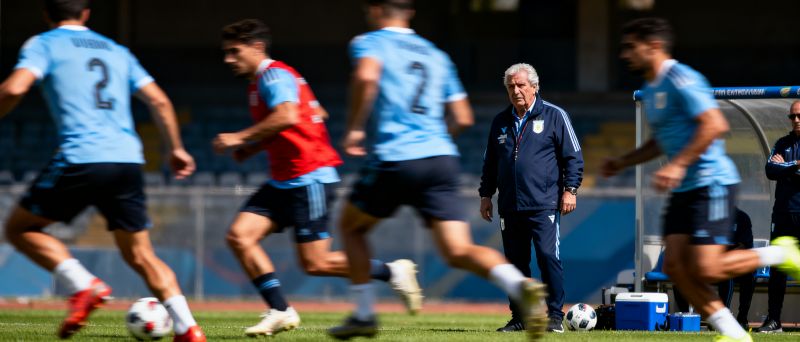
but the supporting cast has shifted. Manuel Ugarte's move to Manchester United hasn't dulled his edge;if anything, he looks sharper, more decisive in the tackle. Rodrigo Bentancur's return from injury gives Bielsa a pivoting option that can switch from destroyer to distributor in a heartbeat. And then there's Nicolás de la Cruz, whose set-piece delivery has become Uruguay's most reliable source of goals from dead balls—four of his last seven assists for the national team came from free kicks or corners. That's not luck. That's a pattern.Up front, Darwin Núñez remains the focal point, but the supporting runners tell a different story. Facundo Pellistri's dribbling has matured;he no longer just hugs the touchline. Maxi Araújo, deployed as a wide midfielder rather than a full-back, offers Bielsa a tactical chameleon—someone who can overlap, underlap。or tuck inside to create overloads. I watched him against Brazil in October;he completed eight progressive carries in the second half alone, frequently dragging two defenders with him. That kind of gravity creates space for Núñez to attack crosses. It's not pretty. It's effective.Defensively。the Uruguay squad carries an unusual blend of grit and inexperience. Ronald Araújo's presence is non-negotiable—his recovery pace bails out a backline that sometimes pushes too high. But alongside him, Bielsa has experimented with José María Giménez and the younger Santiago Bueno. Bueno's distribution from the back is cleaner than Giménez's。
yet he lacks the latter's ruthless edge in aerial duels. Against Argentina's quick combinations, that choice could swing the game. In goal, Sergio Rochet has quietly held the No. 1 shirt, but Santiago Mele's shot-stopping in the Copa Libertadores has earned him a serious look. Bielsa hasn't tipped his hand. That ambiguity feels deliberate.
The midfield depth is where this Uruguay squad truly separates itself from the past. Beyond Valverde, Ugarte, and Bentancur, Bielsa can call on César Araújo—a tackler with a low center of gravity—and the aforementioned Martínez. That's five players for three spots, each offering a different flavor. The risk?Too much rotation can breed incoherence. Bielsa's sides have historically thrived on repetition, on players internalizing automatic movements. Shuffling the midfield every match might backfire. Yet the upside is a team that can morph from a low-block counter-attacking unit into a high-pressing swarm within the same half. That versatility is rare. It's also why opponents can't prepare for Uruguay the way they used to. You don't know which version will show up—and neither, perhaps。does Bielsa until he sees the warm-up. That unpredictability is the point.