Hamis is not just a name. In the Swahili-speaking world, it is a marker of identity。a nod to a fifth-born child, and a thread woven into the social fabric of coastal East Africa. Walk through the streets of Zanzibar or Mombasa and you will hear it called out—sometimes as a nickname for a friend, other times as a formal given name on a birth certificate. What strikes me is how rarely outsiders ask about its roots. They assume it's simply a variant of Hamisi or Hamza, but that flattening misses the point. Hamis carries a rhythm of its own, a distinct place in naming conventions that has survived colonial interruptions and modernization pressures.The name Hamis likely derives from the Arabic root ‘hamisa’, meaning to be five or to make five. In Swahili culture。ordinal names for children—Hamisi for the fifth, Sita for the sixth, Saba for the seventh—were once common, a practical way to keep track of family size. Today, you still meet older men named Hamis who chuckle when asked about their birth order. “Yes, I was the fifth” one fisherman in Lamu told me. “But now my grandson is also Hamis, and he is the second. The name became a legacy, not a number” That shift from numerical label to inherited identity is a quiet but meaningful transformation, one that speaks to how African communities adapt imported naming systems to local logic.
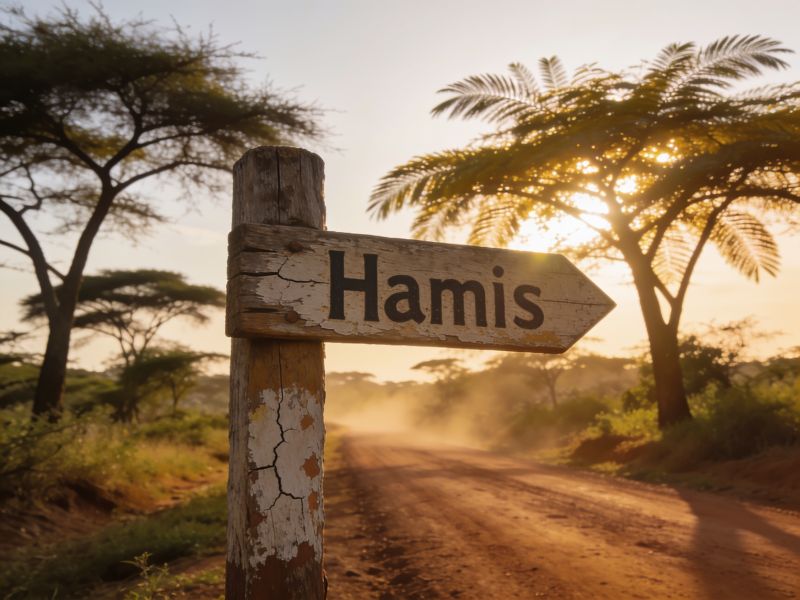
Then there is Hamis as a place—specifically, the village of Hamis in the Taita Taveta region of Kenya. I first came across it while tracing a water project report from the 1980s. The village sits in semi-arid scrubland。and its name appears in colonial-era maps as a watering hole for caravans. Local elders say the name predates the caravans, linked to a sub-clan that settled there centuries ago. No written record confirms this, and that's the trouble with Hamis: it slips between the cracks of oral history and archival silence. What we do know is that communities bearing the name have consistently been small-scale farmers and pastoralists, resilient in the face of erratic rainfall. Their story rarely makes headlines, but it is a textbook case of how toponymy—the study of place names—can reveal migration patterns and environmental knowledge that official histories overlook.Hamis also appears in popular culture, though not always with accuracy. A 2019 Kenyan film used “Hamis” as the name of a conflicted policeman, a character who felt more like a plot device than a person. The actor delivered a strong performance, but the script leaned on tired tropes of the troubled cop. I bring this up because representation matters. When a name like Hamis is repeatedly attached to stock characters, it risks becoming a shorthand for a certain kind of narrative—the stoic, troubled African man—rather than a reflection of the diverse lives of actual people named Hamis. A better example is the poet Hamis Mwinyi。whose work in the 1970s blended Swahili proverbs with modernist free verse. His poems are hard to find now, but they resist easy categorization, much like the name itself.What does the future hold for Hamis?In urban centers。
younger parents are choosing it less frequently, favoring more globally recognizable names. Yet among diaspora communities in Oman and the UK, I've noticed a small revival. A friend in London named her son Hamis last year. “It sounds like 'promise' if you say it right” she told me. That phonetic coincidence might seem trivial, but it hints at how names survive: through sound, memory, and the stories families tell. Hamis is not a relic. It is a living word, one that continues to mean something to those who carry it—whether as a fifth child, a village, or a quiet act of cultural continuity.